


Photography business startup cost depends on what you sell, where you operate, what you already own, and how much financial risk you can carry. A home-based product photographer, an event photographer, and a leased portrait studio have different obligations. Currency conversion cannot make their budgets equivalent because taxes, insurance, imports, wages, and commercial property rules differ. Start with a defined service rather than a generic equipment list. This guide uses hypothetical currency units to demonstrate planning arithmetic, not current prices or market averages. Replace every allowance with relevant local quotes before using the budget to commit money or apply for finance.
01Define the smallest viable service
Write one specific offer: the client, assignment, deliverables, turnaround, usage permissions, and working location. For example, a small-business portrait service might require a portable lighting setup and reliable file delivery but not a permanent studio.
Identify what must work on the first paid assignment and what can wait. Include a failure plan: equipment redundancy, backup storage, and a realistic response to illness or location problems.
This is not an argument for buying everything twice immediately. It is a requirement to understand how you will fulfill promises when an essential component fails, including borrowing or rental arrangements where dependable.
02Separate four different money categories
Create separate lists for one-time launch spending, recurring fixed overhead, variable assignment costs, and cash reserves. A camera purchase belongs in launch spending for cash-planning purposes, while accounting treatment may involve depreciation or another local rule.
A software subscription is recurring overhead; a client album or hired assistant may be assignment-specific. A refundable venue deposit ties up cash without necessarily being an immediate expense.
Keep business reserves separate from your personal living buffer. The U.S.
Small Business Administration provides a useful startup-planning framework, but its institutional context is American and does not establish another country's tax or registration requirements.
03Inventory existing equipment honestly
List what you already own, its condition, compatibility, and whether you can rely on it for the planned service. Existing ownership reduces immediate cash needed, but does not make future replacement free.
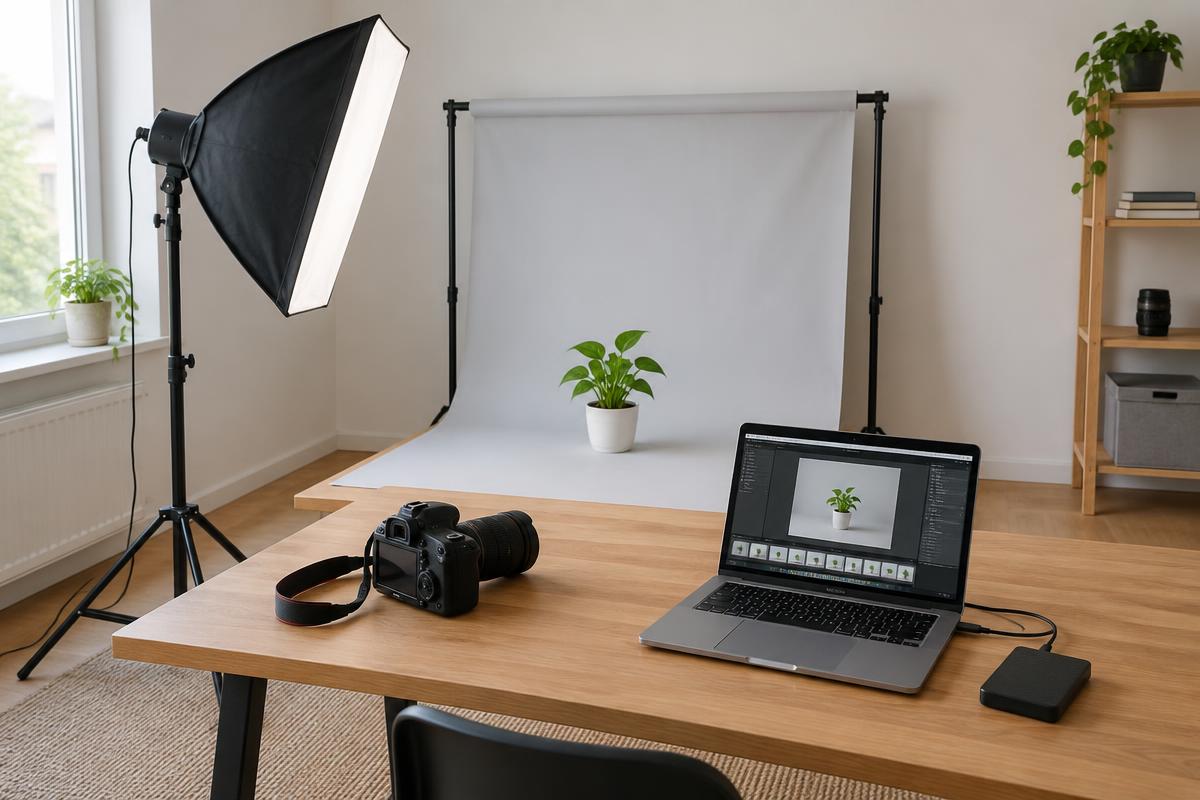
Check bodies, lenses, lighting, stands, batteries, cards, computer capacity, storage, and delivery tools. Avoid replacing usable equipment merely to create a visually uniform kit.
Conversely, do not assume a personal laptop can handle the required workload without testing it. Maintain two figures where useful: cash needed now and an eventual replacement allowance.
This distinction keeps a lean launch realistic without pretending that equipment lasts indefinitely or has no economic cost.
04Price the unglamorous launch tasks
Budget for registration, permits where required, contract review, insurance setup, website preparation, sample products, and initial marketing tests. Check whether you need permission for commercial work in public places, rented premises, or your home.
Insurance categories and exclusions vary; ask a qualified local provider about your actual activities rather than buying a policy based only on its title. Review privacy notices, image-use permissions, booking terms, and data-handling arrangements.
These items may not improve a portfolio photograph, but they support a functioning service. Obtain written quotes and record what each excludes, including recurring renewals that might otherwise surprise you after launch.
05A hypothetical launch budget worked through
Here is an illustrative launch budget in generic currency units: camera and lens additions, 1,400; lighting and support, 450; computer and storage upgrades, 650; administration, insurance setup, and professional review, 400; website and samples, 300. The subtotal is 3,200.
A hypothetical 15% contingency adds 480, producing 3,680 in launch cash. These are invented planning allowances, not quoted prices or recommended market benchmarks.
Some businesses will already own most equipment; others will require substantially different resources. Check whether each local quote includes taxes, delivery, import charges, necessary accessories, and installation before replacing the example figures in your own worksheet.
06Add operating reserves and personal runway
Suppose the same hypothetical business expects fixed monthly cash overhead of 500 units: software and hosting, 90; insurance, 60; marketing tests, 100; workspace and utilities allocation, 150; administration and maintenance allowance, 100. A three-month reserve would be 1,500 units.
Adding it to the 3,680 launch budget gives 5,180 units before personal living costs, assignment-specific cash needs, and any separate tax reserve. Three months is only an example, not a universally sufficient runway.
Choose a reserve based on payment timing, seasonality, commitments, and alternative income. A profitable invoice cannot pay today's bill if the customer will not settle it until later.
07Calculate contribution before break-even
For a simplified hypothetical assignment, assume a fee of 300 units and variable cash costs of 80: travel, 20; outsourced work, 30; delivery or products, 20; payment charges, 10. Contribution is 300 minus 80, or 220 units.
With fixed overhead of 500, cash operating break-even is 500 divided by 220, approximately 2.27 assignments, rounded up to three whole assignments. That calculation excludes owner pay and income taxes, so it is not a living-income target.
The SBA's break-even resource is a planning reference; apply the underlying arithmetic to your own clearly defined costs rather than treating an example as a business forecast.
08Include your time and a recovery target
Continue the hypothetical example by adding a monthly owner-pay target of 1,500 units and a 200-unit allocation toward equipment replacement or recovering launch investment. The contribution target becomes 500 plus 1,500 plus 200, or 2,200 units.
At 220 contribution per assignment, that requires ten assignments before additional tax provision. If each assignment consumes eight hours across communication, travel, photography, editing, and delivery, ten assignments require 80 production-related hours, plus general administration and marketing.
This is a feasibility test, not proof that ten clients exist. Avoid counting owner labor twice: decide whether your model treats it within variable costs or as a separate target.
09A hypothetical founder tests the assumptions
Imagine Priya, a hypothetical photographer planning portable business portraits. Rather than signing a studio lease, Priya obtains rental quotes and tests a small number of paid assignments using an existing camera.
The test reveals that scheduling and editing take longer than expected. Priya revises the time estimate, simplifies the deliverables, and checks whether the resulting fee still supports the contribution target.
Renting remains useful while demand is uncertain, though repeated rental costs may eventually justify ownership. The lesson is not that leasing or buying is wrong.
It is that real workflow evidence should shape fixed commitments before optimistic booking assumptions harden into bills.
10Stress-test local rules and cash flow
Prepare a slow-month version with fewer bookings, a late-payment version, and an equipment-failure version. Check local sales tax, VAT or GST registration, income tax, social contributions, invoice rules, and cross-border obligations with qualified advisers.
Tax collected from customers may be money owed onward rather than spendable revenue. Include borrowing repayments in cash planning, while recognizing that principal and interest can receive different accounting treatment.
Keep exchange-rate risk visible when buying imported equipment or paying overseas suppliers. Common pitfalls are committing to premises too early, confusing revenue with take-home pay, overlooking refunds, and using client booking payments without preserving the ability to fulfill those jobs.
FAQ
11Frequently asked questions and launch checklist
Must I own a studio? Only if the service and economics justify it. Can I launch with existing equipment? Yes, if it reliably meets the work and you have appropriate contingency arrangements. Is break-even the same as success? No; survival, owner income, reserves, and sustainable workload are separate tests. Should I buy or rent? Compare total expected use, availability, financing, maintenance, and flexibility. Before launching, confirm your offer, local obligations, dated quotes, cash reserve, contract, backup workflow, contribution calculation, and realistic client-acquisition plan. Update the budget after actual assignments: a useful startup budget is a working decision tool, not a prediction that must remain unchanged.
Sources & further reading
These references support the technical explanations. Exercises and starting settings are illustrative and should be adapted to your equipment and conditions.
- U.S. Small Business Administration: Calculate your startup costs
- U.S. Small Business Administration: Break-even point
Free resources from LensSuite
Was this guide helpful?