
A photography degree can support work in commissioned photography, studio production, retouching, picture research, visual-content teams and a developing artistic practice. Some graduates combine several activities, while others move into adjacent fields after additional training. The qualification is evidence of study, not proof that every employer will consider you ready for every role. Your next step should connect a specific kind of work to a relevant portfolio, reliable practical skills and an understanding of local hiring conditions. No route described here guarantees employment, commissions or income.
011. Translate modules into evidence
List substantial projects and identify the work you actually performed: researching subjects, arranging access, lighting, editing, colour management, sequencing or delivering files. Replace vague claims such as creative professional with concrete evidence.
A final exhibition might demonstrate project planning and print production; a collaborative shoot might demonstrate coordination and clear handovers. Distinguish what you did independently from what teammates, tutors or external suppliers contributed.
Employers and clients need to understand your responsibility, not merely see that you participated. Keep supporting documents, permissions and production notes where they can be shared appropriately.
022. Consider commissioned photography
Portrait, product, architectural, event and editorial assignments demand different evidence. A product portfolio should show control of surfaces and consistency, while an event portfolio should demonstrate storytelling across changing situations.
The US Bureau of Labor Statistics describes photographers working across varied subjects and settings and notes that many are self-employed. Its occupational profile is US-specific, not a prediction for your location.
Choose one initial specialism for focused practice. Learn how briefs, usage permissions, scheduling and delivery work before presenting yourself as equally prepared for every kind of commission.
033. Explore assisting and studio production
Assisting can involve equipment preparation, safe cable management, lighting adjustments, file handling and maintaining a calm working environment. Studio coordination may emphasise schedules, bookings, consumables and communication instead of taking photographs.
Read actual role descriptions because titles vary widely. Build a concise skills list that distinguishes familiar equipment from equipment you can operate independently and safely.
Ask about supervision, insurance, working hours and responsibilities before accepting an opportunity. Do not agree to hazardous rigging, electrical tasks or working-at-height duties beyond your training merely because they occur on a photographic production.
044. Develop a post-production route
Retouching, image finishing and digital asset work can suit graduates who enjoy careful visual problem-solving and repeatable systems. Prepare before-and-after examples only when you have permission to show the original material.
Explain the brief: removing temporary distractions is different from changing a documentary record or altering product characteristics. Show file organisation, non-destructive editing and consistent delivery alongside polished images.
A fictional exercise could involve preparing twelve products with matching background tone and naming conventions. Accuracy across the set may reveal more about production readiness than a single heavily transformed hero image.
055. Look at picture research and archive work
Picture research may involve finding suitable images, checking rights, tracing sources and maintaining accurate captions. Archive-related work can involve cataloguing, metadata and handling procedures.
These roles are not simply photography jobs without a camera; they can require specialist research, collections or information-management knowledge. Review local vacancies to identify qualification gaps before assuming your degree is sufficient.
Practise describing an image factually, recording creator and rights information separately, and preserving uncertainty rather than inventing details. For sensitive collections, learn the institution’s policies on access, cultural context and responsible description.
066. Assess in-house content roles carefully
Organisations may combine photography with short video, basic design, social publishing or content administration. Read the task list rather than assuming that a content title means mostly image-making.
Identify whether the role needs copywriting, analytics, accessibility or approval management in addition to production. Build examples that demonstrate a coherent set of outputs for a defined audience, but do not imply experience with a real brand when the brief was self-directed.
Label speculative projects clearly. Consider whether the breadth genuinely appeals to you instead of treating every adjacent vacancy as a compulsory next step.
Try this
077. Separate artistic practice from immediate funding
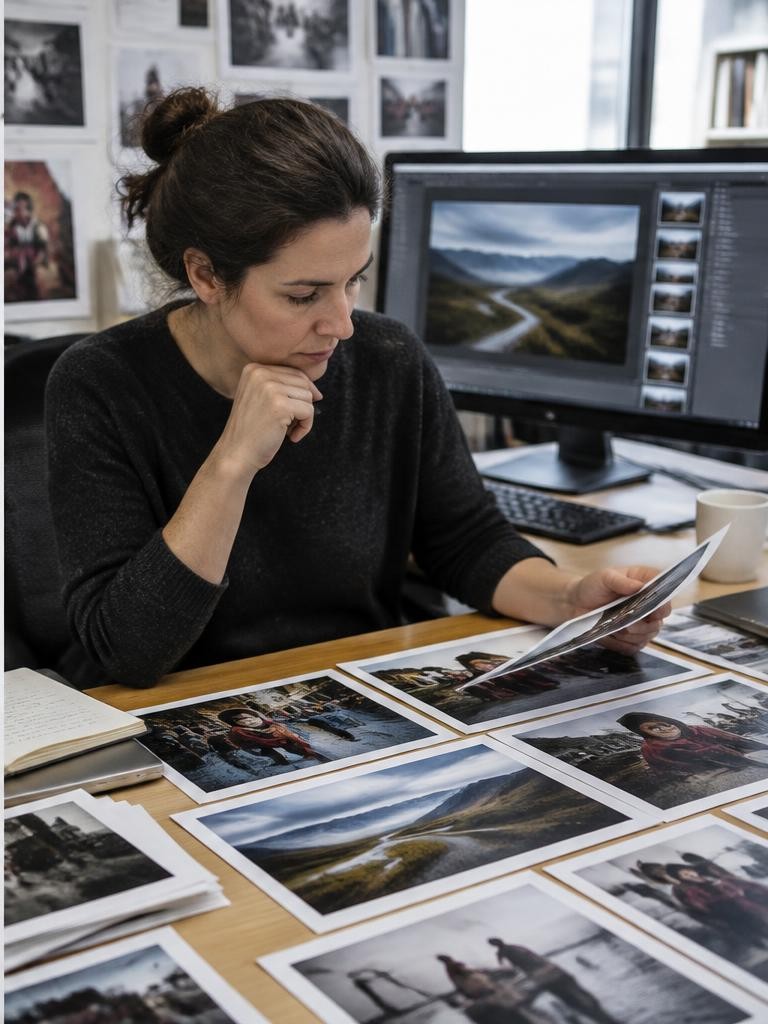
An artistic route may involve exhibitions, publications, commissions, residencies or further study, but selection is uncertain and application work takes time. RIT’s fine-art photography description emphasises technical, conceptual and aesthetic development, illustrating a relevant educational foundation rather than an employment guarantee.
Make a project plan covering research, permissions, production, editing and presentation. Keep a separate plan for living costs and project funding.
A strong artistic rationale does not itself establish a reliable source of money, and rejection does not automatically diagnose the quality of the work.
088. Check teaching and specialist requirements
A photography degree may contribute to eligibility for some teaching, technical or further-study routes, but additional qualifications or experience can be necessary. School teaching requirements depend on jurisdiction and institution; higher-education roles may require postgraduate study or a substantial professional practice.
Scientific, medical and forensic imaging can involve specialist knowledge, controlled procedures and sensitive information. Consult the relevant employer, professional body or regulator rather than treating a general photography qualification as automatic authorisation.
Build a requirements checklist before paying for another course so that further study addresses a genuine, verified gap.
09Illustrative scenario: choosing an initial direction
A fictional graduate has a strong portrait project, careful editing notes and little experience managing commercial delivery. Instead of applying indiscriminately to every visual role, they review ten local advertisements: four assistant roles, three content roles and three retouching roles.
This tiny invented sample is not labour-market evidence. It simply helps them notice which advertised tasks match their current skills.
They prepare an assisting application supported by equipment-handling examples and a separate editing portfolio. They also identify two recurring gaps to practise, without assuming those applications will result in employment.
109. Turn a project into a credible case study
Use a short structure: objective, constraints, your responsibility, process, final deliverables and lessons. For a self-directed portrait series, explain how you arranged consent, selected locations and kept editing consistent.
Show a contact sheet or lighting diagram when it clarifies decisions. Do not claim a campaign outcome, client approval or audience response that did not occur.
If the project was assessed at college, say so. Tailor the opening page to the role: a studio employer may prioritise operational reliability, while an arts opportunity may need a more developed account of intention and research.
1110. Plan working capacity with hypothetical numbers
Suppose a fictional self-directed project requires four hours of research, three hours of preparation, five hours of shooting and six hours of editing and delivery. That totals eighteen hours, not merely the five spent photographing.
If you have nine project hours available each week, allow at least two weeks before additional delays. This example estimates capacity, not earnings.
Include administration, travel, backups and revisions when evaluating freelance commitments. If exploring paid work, calculate costs and obligations separately using your own circumstances; a gross invoice amount is not equivalent to take-home income.
Troubleshooting
12Troubleshooting: diagnose an unproductive search
If applications receive little response, check whether the portfolio matches the advertised responsibilities and whether your contribution is clear. If interviews expose technical gaps, practise those tasks rather than adding unrelated images.
If opportunities are geographically limited, investigate remote-compatible post-production work or realistic relocation requirements without assuming either is accessible. If unpaid requests dominate, check local employment rules and your own financial boundaries.
Keep a record of applications, feedback and skill gaps, but avoid treating a short run of rejections as a permanent verdict. Seek specific feedback from people familiar with the intended role.
FAQ
13FAQ and a thirty-day exercise
Must you freelance? No: some graduates pursue employed roles, mixed work or another field. Does the degree replace a portfolio? Usually not where visual evidence is requested. Should you study further immediately? Only when the course addresses a defined learning goal or verified requirement, not simply to postpone uncertainty.
Exercise: choose one role family, analyse five current local descriptions and map each recurring task to evidence you already have. During the next month, produce one clearly labelled project addressing a genuine gap, rewrite one case study and request focused feedback. Review what improved without promising yourself a particular hiring result.
Sources & further reading
These references support the technical explanations. Exercises and starting settings are illustrative and should be adapted to your equipment and conditions.
Free resources from LensSuite
Was this guide helpful?