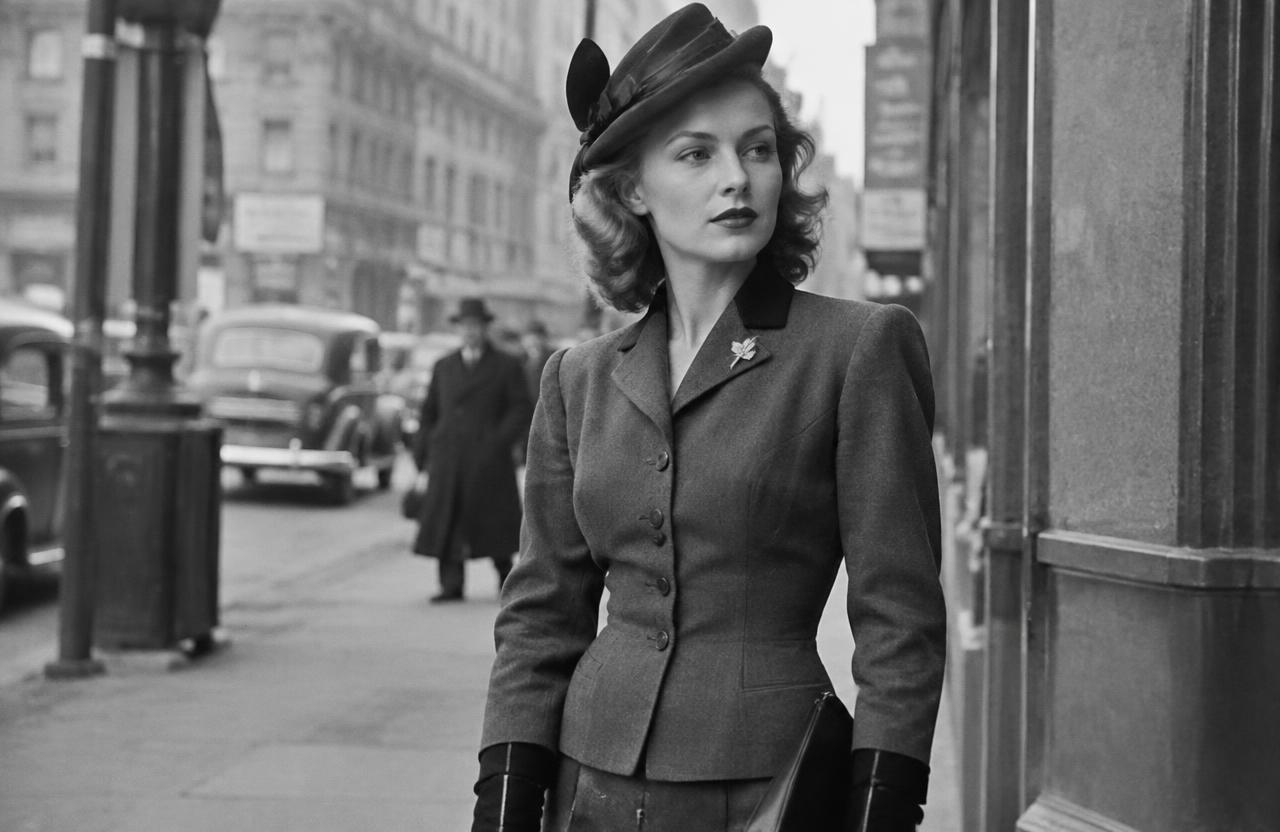
Fashion photography during and after the Second World War cannot be reduced to a simple journey from practical uniforms to glamorous dresses. Photographers, editors, clothing manufacturers, governments, and readers worked within different political and economic circumstances. Britain, occupied France, and the United States did not share identical experiences. Nor did magazine imagery represent everyone's wardrobe. This account concentrates on documented British and American publishing connections and Paris couture, rather than presenting them as a universal history. Its central distinction is between what photographs visibly communicate, what institutions document about their production, and what would require additional evidence about audience behavior.
01Wartime magazines had overlapping purposes
Fashion magazines remained commercial publications, but wartime circumstances complicated their role. Imperial War Museums explains that Britain's Ministry of Information worked closely with women's magazines, including Vogue, as readers faced shortages, clothes rationing, and changes in employment.
That documents an institutional relationship, not proof that every fashion photograph was a government instruction. A single issue could combine clothing advice, advertising, portraits, and reporting.
To interpret an image, first identify its publication date, accompanying caption, placement, and intended readership. An advertisement, editorial fashion story, and commissioned public-information feature may look similar while serving materially different purposes.
02Lee Miller complicates familiar boundaries
Lee Miller's career demonstrates how fashion and wartime reporting could overlap without becoming interchangeable. Imperial War Museums records that she initially worked as a studio assistant at British Vogue and took on more fashion and lifestyle photography as male photographers entered war service.
She later became an accredited correspondent with United States forces. The V&A places this work within a longer career spanning modeling, Surrealism, portraiture, and commercial assignments.
Calling her simply a fashion photographer misses that range; treating her war reporting as fashion imagery diminishes its distinct documentary purpose. Authorship connects these activities, but does not erase their differences.
03Read objects and dates carefully
Museum records help prevent small errors from becoming large historical claims. The V&A identifies Miller's Women with fire-masks, Downshire Hill, London, England as photographed in 1941, while the particular collection print was produced in 2007.
Those dates describe different events. A later print does not make the depicted scene postwar, and a wartime negative does not establish when every reproduction appeared.
A useful verification checklist is: photographer; exact title; exposure date; print date; original publication, if documented; and present collection. Record uncertainties rather than filling them with assumptions about what an image must have meant.
04Constraints changed photographic choices
Clothing restrictions and disrupted working conditions provided a context for fashion imagery, but a photograph rarely explains its own production history. A plain background might reflect aesthetic preference, an editorial brief, limited resources, or several factors together.
Likewise, an outdoor setting does not automatically signify liberation from studio conventions. Analyze visible decisions first: silhouette, fabric texture, pose, lighting, surroundings, and the relationship between clothing and setting.
Then look for correspondence, captions, or publication records that support a contextual interpretation. Avoid converting a plausible explanation into a documented motive merely because the picture seems to fit a familiar wartime narrative.
05War reporting was not an aesthetic accessory
Miller's movement into reporting brought subjects that demand a different ethical register from clothing promotion. Imperial War Museums dates her arrival in Normandy to July 1944, after the initial Allied landings; describing her as photographing the D-Day landings themselves would therefore be misleading.
Her wider wartime work also included the consequences of Nazi violence. When discussing fashion and war together, do not use atrocity imagery as decorative contrast to glamorous photographs.
Establish assignment, location, and subject before making stylistic comparisons. A shared photographer or magazine can explain circulation, but cannot make radically different human experiences equivalent.
06The New Look was influential, not universal
Christian Dior's first collection in 1947 introduced the silhouette associated with the New Look: rounded shoulders, a closely defined waist, and a full skirt. The Metropolitan Museum of Art interprets it against the preceding years of uniforms, shortages, and restrictions.
That makes it an important postwar fashion development, not evidence that women everywhere immediately abandoned practical clothing. Couture occupied a particular social and commercial position.
Recovery, rationing, purchasing power, climate, work, and personal preference differed across countries and households. Separate the prominence of a silhouette in editorial imagery from its availability, adoption, and everyday usefulness.
07Postwar photographs were not one style
Specific museum objects offer firmer ground than sweeping claims about a completely new photographic era. The Met records Richard Avedon's Workroom, House of Dior, Paris, August 1947, establishing a connection between the photographer and the couture workplace that year.
It also records Irving Penn's Dior Dress (Dorian Leigh), New York, dated and printed in 1949. These objects support discussion of particular photographers, garments, locations, and dates.
They do not, by themselves, prove that all postwar fashion photography became spontaneous, luxurious, or psychologically complex. Compare individual images before assigning a whole decade a single visual identity.
08Advertising influence is not proven causality
Advertising and editorial fashion imagery could circulate ideals of appearance, consumption, and femininity. That is different from demonstrating that a campaign caused a particular change in purchasing or employment.
Images can establish what an advertiser presented; circulation records can indicate potential exposure. Stronger causal claims require additional evidence, such as audience research, sales analysis with competing explanations considered, correspondence, or documented policy objectives and outcomes.
Be especially cautious with statements that photographs sent women back into domestic life. Such claims compress employment policy, household economics, discrimination, and individual choices into a single visual cause that the photographs alone cannot establish.
09A hypothetical comparison worked through
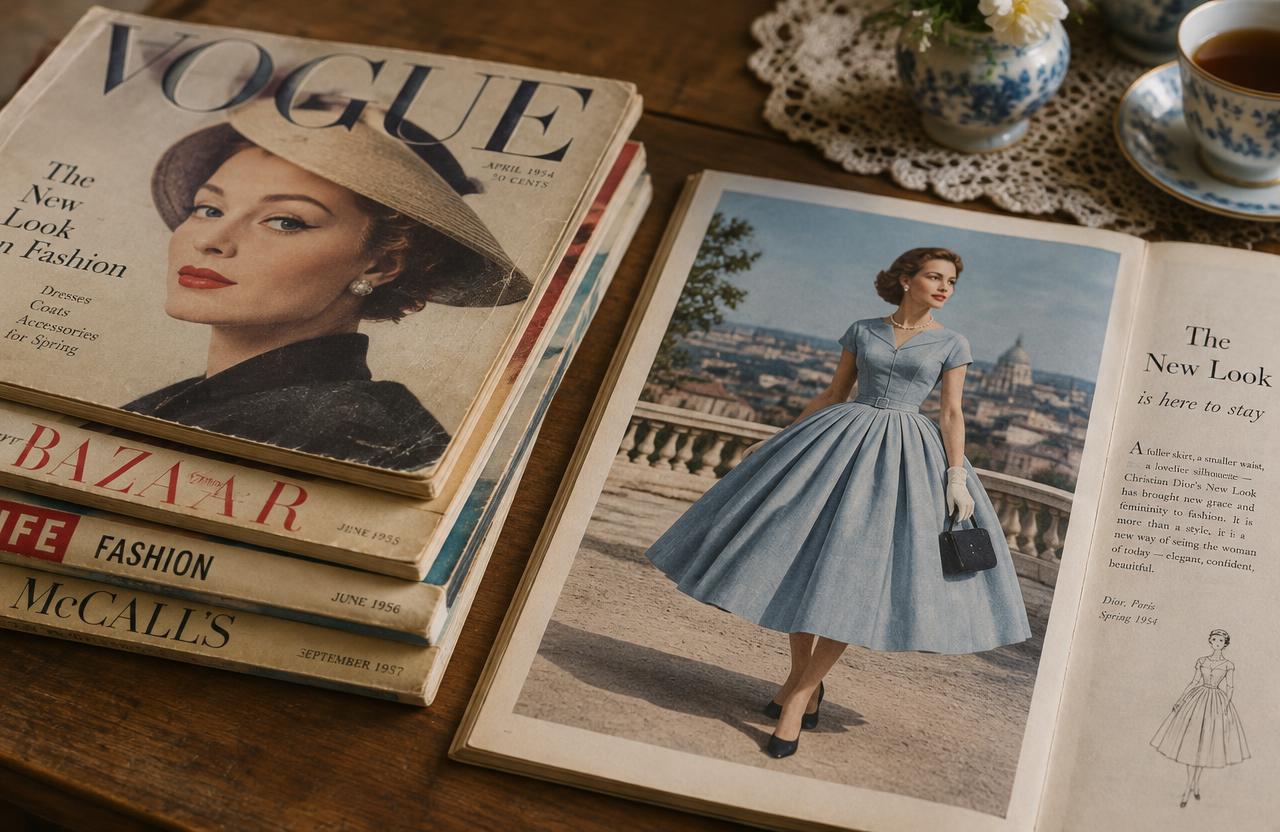
Imagine a student comparing a verified British wartime clothing editorial with a verified 1949 couture photograph. This is a hypothetical exercise, not a description of a particular unpublished pairing.
First, record the dates and publication contexts. Next, describe only visible differences: perhaps a straighter silhouette versus a fuller skirt, or a contextual setting versus an isolated figure.
Then separate observation from interpretation. A fuller skirt is visible; an aspiration toward abundance is an interpretation requiring context.
Finally, write the limitation: these examples reveal editorial choices within their publications, not what all women wore or how every reader responded.
10A practical research and writing checklist
Build a short evidence file before drafting. Use museum object records for identification and institutional essays for interpretation.
Check whether a date belongs to the negative, print, garment, or magazine issue. Distinguish advertising pages from editorial pages whenever original layouts survive.
Note the country and readership rather than treating Vogue as one undifferentiated publication. Attribute interpretive arguments instead of presenting them as uncontested facts.
Common pitfalls include assuming the war ended material restrictions everywhere at once, confusing image circulation with garment ownership, and describing elite fashion as universal experience. If reproduction rights are unclear, link to the institution rather than republishing its image.
FAQ
11Frequently asked questions
Did fashion photography stop during the war? No; the documented British Vogue material shows continued fashion and lifestyle production alongside changing wartime responsibilities. Did Dior invent postwar fashion photography? No. A clothing collection and a photographic practice have related but distinct histories. Did advertising influence readers? It offered persuasive imagery, but the size and direction of any effect require evidence beyond the images. What should beginners study first? Compare a small number of well-documented objects and their original contexts. The most useful conclusion is rarely that everything changed overnight; it is that continuity and change coexisted unevenly.
Sources & further reading
These references support the technical explanations. Exercises and starting settings are illustrative and should be adapted to your equipment and conditions.
- Imperial War Museums: Lee Miller's Second World War
- V&A: Everything you need to know about Lee Miller
- V&A: Women with fire-masks object record
- The Metropolitan Museum of Art: Christian Dior (1905–1957)
- The Metropolitan Museum of Art: Workroom, House of Dior, Paris, August 1947
- The Metropolitan Museum of Art: Dior Dress (Dorian Leigh), New York
Free resources from LensSuite
Was this guide helpful?