A good first camera is one you can afford to use, understand, and carry regularly. Before comparing products, write down three subjects you actually want to photograph and the conditions in which you will meet them. A family portrait near a window, a moving dog outdoors, and a distant bird create different demands. Add your intended output: phone sharing, a website, or prints of a particular size. This short brief prevents an expensive mistake: buying impressive features that solve someone else's problem. There is no universal beginner camera, and learning does not require immediately purchasing a new interchangeable-lens system.
01Test what you already own
Use your current phone or camera for a deliberate practice week. Photograph the same subject in open shade, direct sunlight, and dim indoor light.
Try a moving subject and a close detail. Review what genuinely prevented the result you wanted: limited reach, unreliable focus, awkward controls, or difficulty keeping motion sharp.
Distinguish equipment limits from technique. A tilted horizon or cluttered background will not disappear with a larger sensor.
Keep a simple limitation log containing the situation, attempted adjustment, and remaining problem. If no repeated equipment limitation emerges, more practice may offer better value than an immediate purchase.
02Understand the main camera routes
A phone prioritizes availability and computational processing. A fixed-lens camera offers an integrated package whose lens cannot normally be exchanged.
An interchangeable-lens camera offers flexibility but introduces lens choices, compatibility questions, and additional carrying weight. DSLR and mirrorless systems can both teach exposure, focus, and composition; age or category alone does not determine suitability.
Compare the actual products and support available where you live. Avoid treating any format as a guaranteed shortcut to professional-looking photographs.
Your lens, light, subject movement, technique, and processing all contribute to the final image, alongside the camera's capabilities.
03Set a complete hypothetical budget
Use a total-spending ceiling rather than a body-only allowance. Here is a hypothetical budget in generic currency units, not current prices: camera and lens, 620; suitable memory card, 30; spare battery, 50; protective bag, 40; backup storage, 80; contingency, 80.
The total is 900 units. These allocations are illustrative and may not match your market.
Replace every figure with a dated local quote, including taxes and delivery. Check what the package already contains so you do not double-count a battery or charger.
If the complete kit exceeds your ceiling, simplify the purchase rather than sacrificing necessary storage.
04Choose the lens and system together
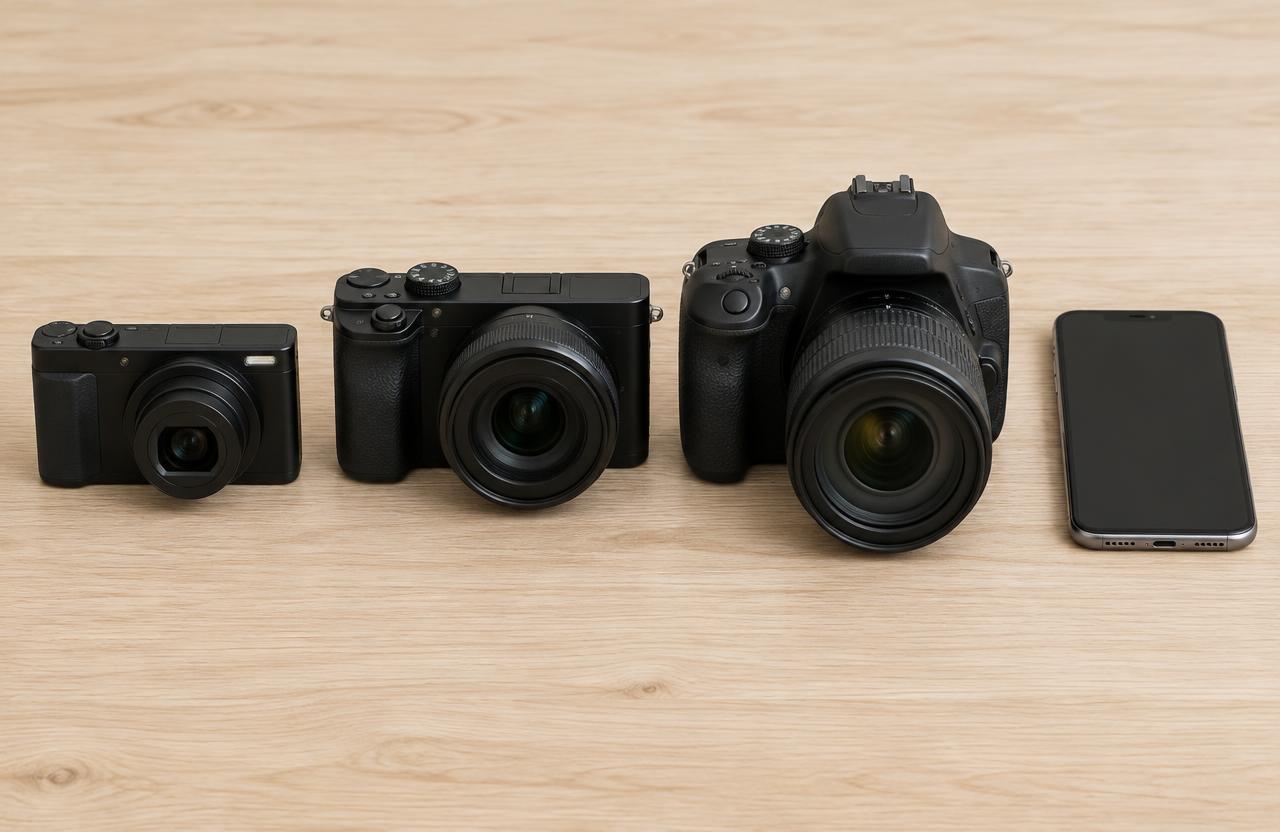
A camera body without a suitable lens may be a poor solution even when its specifications look impressive. Identify the field of view you need, whether you want to zoom, and how close you must focus.
Check the exact mount and the manufacturer's compatibility information; an adapter does not automatically preserve every function. Include lens size and weight in your carrying assessment.
Start with one versatile lens if it covers your actual brief. Build a system plan around a plausible next step, not an imaginary collection.
Manufacturer guidance can explain features, but remains commercial advice rather than independent market comparison.
05Compare features against real tasks
For moving subjects, investigate focus behavior and the practical shooting experience, not just a headline burst number. For travel, weigh the camera with its lens, battery, and normal accessories.
For indoor portraits, consider available light, lens options, and whether adding light would solve the problem more directly. If video matters, verify recording limits, microphone options, stabilization behavior, and power arrangements in the exact model's documentation.
Make a shortlist with three must-haves and three nice-to-haves. A product that fails a genuine must-have should not win simply because it offers many unrelated features or a particularly attractive promotional bundle.
06Handling deserves a real test
Whenever possible, handle the camera with the intended lens attached. Can you reach the main controls without changing your grip?
Can you read the display comfortably and compose in bright conditions? Try changing shutter speed, aperture, focus area, and exposure compensation after a brief explanation.
Check whether the grip suits your hands and whether the strap arrangement feels secure. People with different mobility, vision, or dexterity needs may reach very different conclusions about the same design.
If purchasing remotely, read the return conditions before ordering. Comfortable handling is a practical criterion, not a reward reserved for experienced photographers.
07Buy used with a structured inspection
Used equipment can widen your options, but condition and seller terms matter more than a vague bargain label. Ask about faults, repairs, included accessories, return rights, and any warranty.
Inspect the mount, ports, battery compartment, controls, viewfinder, and screen. Photograph a plain surface and a detailed subject at several settings, then inspect the files.
Examine a lens for damage and functional problems rather than expecting cosmetic perfection. A shutter count, where available, is only one piece of evidence; it is not a guarantee of remaining life.
Walk away if testing is refused or a seller cannot explain important inconsistencies.
08A hypothetical beginner's worked decision
Imagine Sam, a hypothetical beginner who wants family photographs and lightweight weekend travel. Sam has a 900-unit total ceiling and no interest in video.
A body-only offer looks attractive, but the required lens pushes the complete system beyond the limit. A second option includes a suitable lens and leaves room for storage and contingency.
Sam handles both and finds the second easier to operate. The decision is not that this unnamed camera is universally better; it meets Sam's documented brief at an acceptable total cost.
Renting or borrowing first would provide another useful check before committing.
09Learn before buying the next accessory
For the first month, practice with the same small kit. Week one: learn focus selection and review sharpness.
Week two: vary shutter speed with moving subjects. Week three: explore aperture, subject distance, and background separation.
Week four: practice exposure compensation and review a histogram. Nikon's explanation describes the histogram as a distribution of tones from dark to light, making it useful for evaluating exposure rather than judging only the screen's apparent brightness.
Keep notes about missed photographs. Buy an accessory only when those notes identify a repeated limitation it can reasonably solve.
10Avoid the common comparison traps
Do not compare bodies while ignoring lenses, compare advertised prices with different tax treatment, or assume an older product has become incapable of making good photographs. Avoid unsupported claims that one sensor size always produces a particular look.
Depth of field depends on several interacting choices, and image quality must be judged at an intended output. Check exact model names, regional variations, and included accessories before paying.
Save the relevant documentation and purchase terms. If a recommendation promises effortless results without mentioning light, technique, or compatibility, treat that simplicity as a reason to investigate rather than a reason to rush.
FAQ
11Frequently asked questions
Do beginners need manual mode? No, but understanding shutter speed, aperture, and ISO helps you use automatic modes intentionally. Is a phone enough? It can be, especially while learning composition and identifying genuine limits. Should I buy the newest model? Only if its relevant benefits justify the complete cost to you. How many lenses should I start with? One suitable lens is often a sensible learning constraint, not a universal rule. What is the final checklist? Confirm your subject brief, total budget, handling, compatibility, seller protection, storage plan, and one achievable practice project before you buy.
Sources & further reading
These references support the technical explanations. Exercises and starting settings are illustrative and should be adapted to your equipment and conditions.
- Nikon: Best Nikon Mirrorless Cameras for Beginners
- Nikon: Learning How to Use Your Camera's Histogram
Free resources from LensSuite
Was this guide helpful?