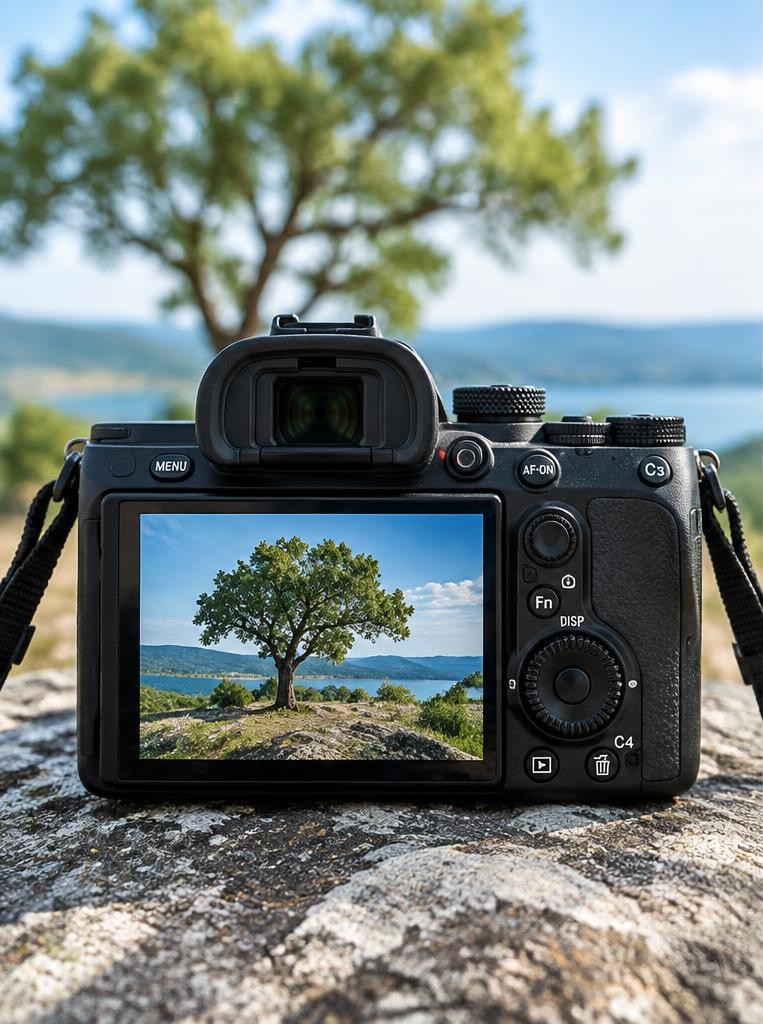
For most beginners, the best travel camera is the one you can comfortably carry all day: start with your phone, or choose a small mirrorless body with one versatile zoom. Among the researched options here, the OM SYSTEM OM-5 suits lightweight outdoor kits, the Fujifilm X100VI suits fixed-lens simplicity, and the Sony a7C II suits higher-budget full-frame flexibility. These are research-based recommendations, not hands-on test results.
01Judge the complete kit, not just the sensor
Compare body, lens, spare battery and bag together. A compact full-frame body can become a heavy system once you add a bright zoom.
Set a personal carry limit before shopping—perhaps 1kg for camera equipment—and weigh what you already own.
Battery endurance, charging arrangements, comfortable controls and focal-length coverage matter more on a long day than a small megapixel difference. Check whether the camera charges from your intended USB power source; connector shape alone does not prove compatibility.
02Smartphone, compact, mirrorless or DSLR?
A smartphone wins for minimal extra weight, easy sharing and computational processing. Its limitations become clearer with distant wildlife, demanding action and some low-light situations.
A large-sensor compact improves dedicated controls while keeping the lens permanently attached.
Mirrorless cameras offer interchangeable lenses, electronic previews and broad system choices. DSLRs can be excellent used value, particularly if you already own lenses, but typical travel kits are bulkier.
Do not replace a working DSLR just because newer cameras exist; compare the actual equipment you would carry.
03A comparison table in prose: four real options
Read these rows as sensor; ready-to-shoot weight including battery/card but excluding interchangeable lenses; lens arrangement; approximate US-dollar price. Retail examples are snapshots, not worldwide quotes, and local taxes, availability and warranties differ.
Fujifilm X100VI: 40.2MP APS-C; 521g; fixed 35mm-equivalent f/2; about US$1,800 new. Sony a7C II: 33MP full-frame; 514g; interchangeable Sony E mount; about US$2,500 body-only.
Original OM SYSTEM OM-5: 20.4MP Micro Four Thirds; approximately 414g; interchangeable lenses; about US$900 body-only at the cited retailer. Ricoh GR III: 24.24MP APS-C; 257g; fixed 28mm-equivalent f/2.8; approximately US$1,030–1,470 used at the cited dealer.
Troubleshooting
04Fixed-lens choice: X100VI or GR III?
The X100VI combines a hybrid viewfinder, tilting screen and stabilisation with a general-purpose 35mm-equivalent view. It is not pocket-sized in the same sense as the GR III.
Fujifilm specifies roughly 450 still images in economy mode; operating mode changes endurance.
The GR III is smaller and wider, with around 200 CIPA-rated shots and no built-in viewfinder. Ricoh now labels it discontinued, so treat it as a used or remaining-stock purchase.
Neither gives an optical zoom. Avoid scarcity premiums unless the handling and fixed focal length genuinely suit you.
05Mirrorless choice: OM-5 or a7C II?
The original OM-5 is attractive for small outdoor kits, with IP53-rated protection under specified conditions and stabilisation. Pair it with suitable weather-protected lenses; the rating is not permission to submerge it.
Distinguish original OM-5 listings from later models when comparing prices.
The a7C II provides a larger sensor, subject-recognition autofocus and interchangeable-lens flexibility. Its compact body does not make full-frame lenses weightless.
Choose it when the image-making requirements justify the complete system price, rather than assuming full frame is automatically the best beginner travel format.
Worked example
06Worked packing example: keep the numbers honest
Consider an illustrative 1kg camera-equipment allowance. An X100VI weighs 521g.
Budget another 50g for a spare battery and 250g for a light pouch, strap, card and charging accessories: approximately 821g total. Accessory weights are planning allowances, not manufacturer specifications.
Substitute a 514g a7C II and an assumed 300g lens while retaining those allowances: 1,114g. That exceeds the target by 114g before a second lens.
The lesson is to weigh the complete kit, not compare body weights alone.
07Budget tiers: where your money goes
Under US$500, start with your existing phone or investigate a used camera-and-lens kit with a warranty. This is a budget strategy, not a claim that every market has an equivalent deal.
Prioritise a sound battery and functioning lens over a prestigious badge.
Around US$1,000–1,500, the cited OM-5 body price leaves some budget for a lens, while used GR III prices buy portability rather than zoom versatility. Around US$1,800, the X100VI includes its lens.
At US$2,500 and above, remember that the Sony body still needs one.
08What to buy first—and what to postpone
Buy the lens coverage you need, a reliable memory card, a protective carrying solution and a spare battery before adding specialist accessories. For general travel, a zoom covering roughly 24–70mm equivalent is a useful starting range, not a mandatory specification.
Practise downloading and backing up photographs before departure. Postpone a second body, large flash and specialist telephoto until your itinerary requires them.
Renting can reveal whether a fixed lens feels liberating or restrictive without turning that uncertainty into an expensive purchase.
09What a first lightweight trip can look like
Illustrative scenario: a beginner plans a weekend of streets, cafés and coastal walks. Instead of packing three lenses, they take one small zoom and a phone.
After the first day, most pictures fall between wide views and short portraits.
Their next purchase is not automatically another lens. They first review which missed photographs mattered.
If distant birds were central to the trip, extra reach could be justified; if not, keeping the kit small may be the better decision.
Troubleshooting
10Troubleshooting: one lens, two lenses and weather
If constant lens changes make you miss moments, the cause is usually overlapping coverage or an unsuitable primary lens. Try one zoom for a day.
Add a second lens only for a distinct need, such as distant wildlife or low-light portraits.
If rain threatens, use a cover and keep changes sheltered. Weather resistance is not waterproofing.
Fujifilm’s X100VI weather-resistance setup requires the specified adapter ring and protective filter. After cold conditions, let equipment warm inside a closed bag to reduce condensation risk; avoid wiping grit across wet glass.
FAQ
11FAQ: batteries, megapixels and zoom
How many batteries? One spare is a sensible starting provision for a day near charging, but cold, video and heavy reviewing may justify more. CIPA figures are standardised comparisons, not exact daily predictions.
Is 24MP enough? It is ample for many travel uses; lens quality, focus and output size matter too. Does digital zoom replace a longer lens? Cropping narrows the view but discards pixels. A fixed-lens compact cannot provide every viewpoint or the reach needed for distant subjects.
12A 15-minute pre-purchase checklist
Spend five minutes listing your three main subjects and maximum complete-kit budget. Spend five weighing your current kit or assembling a realistic body-plus-lens weight total.
Use the final five to check local availability, returns, warranty terms and battery costs.
Before paying, handle the camera if possible and compare manufacturer specifications with the exact listing. Verify whether a quoted price includes a lens and whether stock is new, used or imported.
The best purchase is a kit you understand and will carry, not the winner of a specification contest.
Sources & further reading
These references support the technical explanations. Exercises and starting settings are illustrative and should be adapted to your equipment and conditions.
- Fujifilm: X100VI specifications and weather-resistance conditions
- Bedfords: X100VI retailer price
- Sony: a7C II features
- B&H: a7C II price and specifications
- OM SYSTEM: Original OM-5 launch specifications
- Precision Camera: Original OM-5 price and specifications
- Ricoh: GR III discontinued status
- Ricoh: GR III specification brochure
- MPB: Used GR III listings
Free resources from LensSuite
Was this guide helpful?