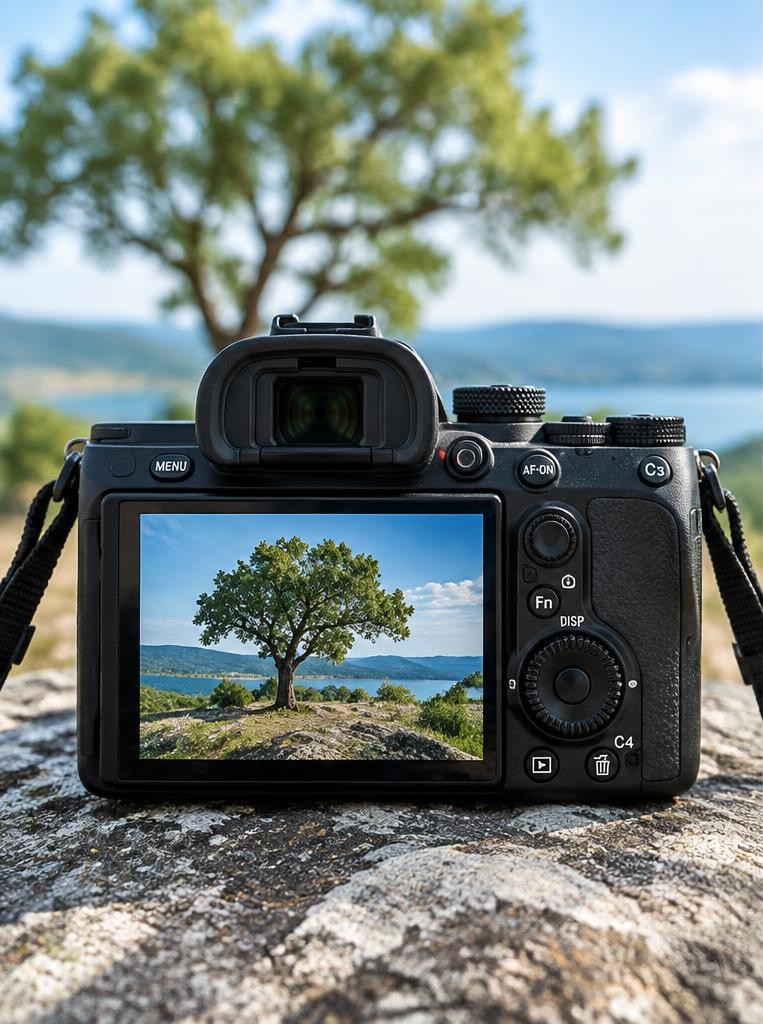
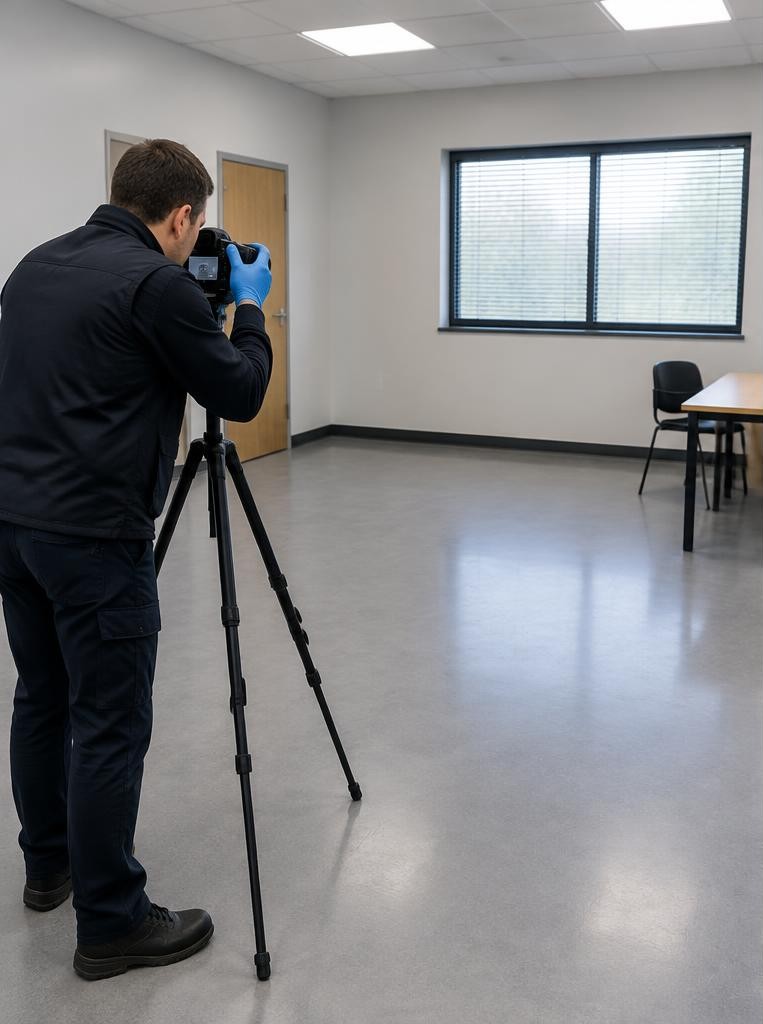
Crime-scene photography is specialised work for authorised, trained practitioners under governing law and agency procedure. This educational overview grants no scene access and is not a substitute for professional instruction. Safety, scene control and preservation come before an image. Lighting makes visible information recordable. It can reveal texture, reduce unwanted shadow or expose reflective detail. It can also alter how a surface appears. The objective is an understandable record, not a dramatic image or a visual claim about a mark's origin.
01Record context before a lighting experiment
Follow the responsible authority's documentation sequence. Overall views establish location, midrange views relate features to surroundings and close views show detail.
Exact numbers, scale use and file settings depend on current agency requirements.
Document the scene as found when required before changing lights or introducing equipment. Supplemental-light images should add information to the prescribed baseline, not replace it.
Record relevant setup changes so a later viewer can distinguish ambient appearance from specialised illumination.
02Ambient light can be uneven
Windows, room lamps and streetlights can produce mixed colour, deep shadows and glare. A bright background may cause an automatic meter to darken important interior detail.
Review exposure and focus at the intended plane rather than judging only the overall screen brightness.
Do not move curtains, fixtures or objects for a preferred photograph without authorisation. Equipment placement, protective measures and the sequence of work must follow scene controls.
If a view cannot be made without disturbance, report the limitation rather than improvising.
03Even supplemental light and direct flash
An approved flash or lamp can help record detail where available light is insufficient. Direct camera-mounted flash can flatten relief or produce specular reflections.
Off-camera direction or diffusion may change those effects, but can also alter shadow and colour.
A brighter or more attractive frame is not automatically a more accurate record. Preserve required views and document the additional illumination.
Avoid equipment contact with evidence and keep cables and stands out of authorised working paths.
04Oblique light reveals surface relief
Low-angle illumination travels across a surface, allowing small ridges or impressions to cast shadows. Different light directions can reveal different features.
A shadow is an effect of illumination, not independent proof of depth, identity or cause.
A useful comparison includes an appropriate neutral view and clearly identified oblique-light views. Interpretation belongs to qualified personnel using validated methods and context.
Never touch or move material merely to obtain a stronger shadow.
05Scale and colour need controlled handling
A scale can communicate size when introduced according to procedure. It must not obscure or disturb the feature.
Camera angle, lens distortion and alignment affect measurement interpretation; a ruler in a photograph does not automatically establish accuracy.
Mixed light can change colour rendering. An authorised neutral or colour reference may help a controlled workflow, but introducing it must respect contamination controls.
Preserve originals, use approved colour management and document any permitted derivative processing.
06Exposure choices change the visible record
Inspect highlight clipping, deep shadows and focus before accepting a frame. A stable support may help repeatability when authorised.
Choose aperture for required depth of field and use a suitable shutter and ISO under the governing recording procedure.
In a classroom comparison, changing from 1/125 to 1/60 at fixed aperture, ISO and steady light roughly doubles ambient exposure. Flash contribution may behave differently within the camera's operating limits.
This example explains a technical relationship; it is not an operational scene prescription.
07A hypothetical classroom comparison
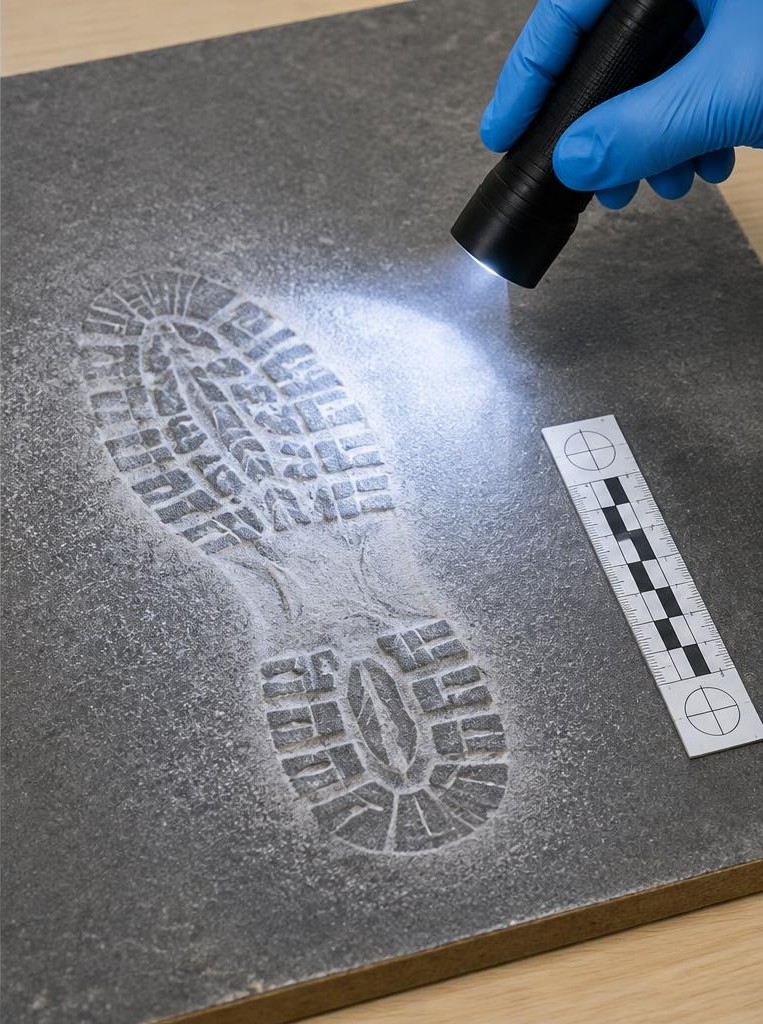
In a clearly staged training room, a trainee photographs a shoe impression made in a non-evidentiary practice medium. They first record context and an ordinary-light view.
Without touching the impression, they make another frame using a torch at a low angle.
Texture becomes easier to see, but one shadow also looks deeper. The trainee labels the lighting condition and compares original files.
This fictional exercise illustrates why additional views and notes matter. It does not establish that a similar-looking real mark has evidentiary significance.
08Preserve originals and explain derivatives
Follow the agency's transfer, storage, access and retention rules. Keep original captures unchanged and preserve required metadata and audit records.
Any permitted derivative processing should be documented and reproducible.
Do not clone, remove, generate, composite or selectively alter content to strengthen or weaken a feature. Do not silently replace a failed original with a corrected frame.
The applicable policy determines how additional photographs and presentation copies are recorded.
FAQ
09FAQ and responsible further learning
Does oblique light identify a shoe or prove a mark's origin? No. Does a scale make every photograph measurable? No. Can a tutorial authorise an active-scene practice session? No.
For learning, use a permitted staged classroom and a harmless practice object. Compare even and directional light, label each condition and retain originals. For operational work, obtain appropriate training, check current jurisdictional procedures and consult qualified supervisors. Lighting supports evidence documentation; it does not replace authority, interpretation or integrity.
Sources & further reading
These references support the technical explanations. Exercises and starting settings are illustrative and should be adapted to your equipment and conditions.
- NIST / OSAC: Standard Guide for Crime Scene Photography
- Crime Scene Investigation: A Guide for Law Enforcement
Free resources from LensSuite
Was this guide helpful?