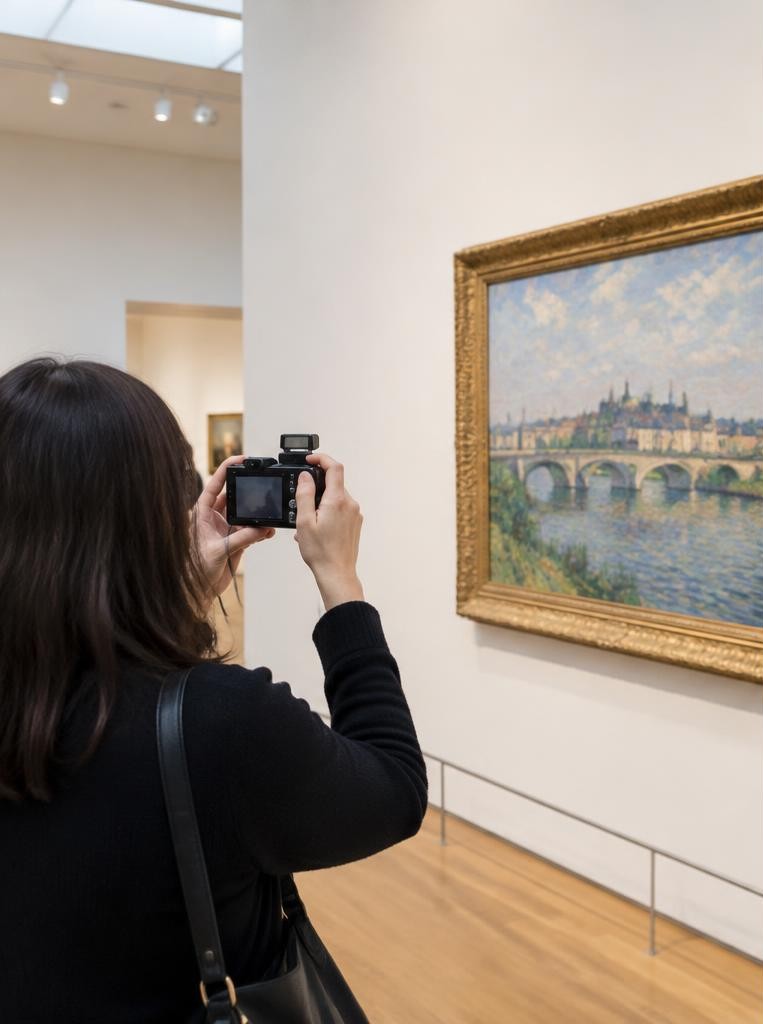
Museums restrict flash photography for several reasons: repeated light exposure can contribute to cumulative damage in light-sensitive materials; sudden flashes can distract visitors and disrupt staff or performances; and equipment use may create safety, conservation, or copyright concerns. A flash does not instantly destroy every artwork. The risk depends on the object's sensitivity, the intensity and duration of exposure, the distance, and the total light dose accumulated over time. Museums set rules for collections and visitor environments rather than asking each person to calculate an object's tolerance. Policies differ by institution, gallery, and exhibition. Some permit non-flash photography in designated areas, while others prohibit photography or restrict specific objects. The safest rule is to check posted guidance and staff instructions before taking a picture.
01Light damage is cumulative, not a one-flash catastrophe
Light can fade dyes and pigments, weaken paper and textiles, or contribute to other material changes. Risk is related to the object's sensitivity and its cumulative exposure, often understood through both light intensity and duration.
An intense light for a short period and a lower light for a longer period can contribute to dose, though the relationship is not a simple visitor-facing calculator. Some changes may be irreversible.
A single ordinary camera flash does not mean that every painting or sculpture is immediately ruined; many materials are comparatively stable, and museums evaluate risks using conservation knowledge. But visitors generally cannot see an object's sensitivity, prior exposure, or the gallery's lighting plan.
Prohibiting flash is a practical precaution that prevents uncontrolled additions to exposure, especially for vulnerable works and in busy rooms where many flashes could accumulate.
02Why paper, photographs, textiles, and pigments can be vulnerable
Sensitivity varies widely. Watercolors, dyed textiles, works on paper, photographs, and some organic materials may be especially vulnerable to light.
Other objects, including many stone or metal works, may tolerate light better, although they can have other conservation needs. A single artwork can combine materials with different sensitivities: a painting may include a fragile colorant, paper support, varnish, and later restoration.
Light can cause fading or chemical change that cannot simply be reversed by restoring the original brightness. Conservation staff assess the object, exhibition duration, display lighting, and past exposure, then set conditions appropriate to that collection.
A visitor cannot reliably identify a safe flash by looking at an object. The apparent robustness of a framed work does not reveal its pigments, support, or conservation history.
03Why museums cannot make an exception for each visitor
A gallery may host hundreds or thousands of visitors, each potentially taking several photographs. Even if one flash contributes a small dose, repeated exposures across many visitors can add up.
Staff cannot reliably assess every device, flash power, distance, angle, or number of shots while also protecting the collection and supporting visitors. A clear no-flash rule is easier to communicate and enforce than a case-by-case permission system.
Rules may also be shaped by loan agreements: lenders can specify conditions for display and photography. Exhibition organizers may have contractual or copyright restrictions, especially for contemporary works or special exhibitions.
A museum's policy reflects more than the physical sensitivity of the artwork. It may balance conservation, rights, visitor experience, security, and operational needs.
A sign is a venue-specific instruction, not a claim that all artworks are equally fragile.
04Flash can affect other visitors and museum work
A sudden burst of light can startle or distract people who are reading, looking closely, or attending a guided tour. It may interrupt a performance, reflection, or educational activity.
Flash can also interfere with photography or recording by other visitors and staff, and intense light may be uncomfortable for people with particular sensory needs. In crowded spaces, people stepping backward to frame a photograph can create collision risks, while tripods and selfie sticks may obstruct paths or exits.
Museums are shared public environments; photography etiquette includes awareness of people as well as objects. If you take permitted photographs, avoid blocking a view, keep walkways clear, and give others time to enjoy the work.
A quiet, non-flash image is often more considerate and may better represent the atmosphere of the gallery.
05Why phone cameras still may be restricted

A phone's flash may be less powerful than a professional speedlight, but the institution's rule usually applies to all flash photography. A phone may also use screen illumination, computational multi-frame capture, or bright assist lights that can distract visitors even if they are not traditional flashes.
Low-light processing can produce a usable picture without flash, but it may increase noise or blur. Museums may prohibit photography entirely for reasons unrelated to light, including copyright, loan conditions, privacy, security, or a temporary exhibition agreement.
Do not assume that a small device is exempt. Check the posted policy, ask a staff member if uncertain, and disable automatic flash before entering galleries.
Also verify whether photography is allowed at all; permission to take a picture does not necessarily include permission to publish it commercially.
Worked example
06A numerical example: how repeated exposures add up
Consider a hypothetical gallery where one permitted photograph uses a small amount of light, and imagine a light-sensitive drawing receiving dozens of visitor flashes each hour. The museum would have to consider the combined exposure across the exhibition, not only the energy from one visitor.
If 100 people each take five photographs, the object faces 500 flash events during that period. This simple count does not calculate actual damage: flash output, distance, direction, spectrum, the object's sensitivity, and ambient lighting all matter.
It illustrates why cumulative exposure is the relevant idea and why a policy cannot depend on each visitor's judgment. Museums monitor light conditions and exposure schedules for vulnerable works; visitors can help by following the rules rather than trying to determine whether their own flash is harmless.
07Hypothetical story: a visitor and a watercolor
Imagine a visitor entering a gallery with a phone whose flash is set to automatic. A dim room prompts the camera to fire while the visitor photographs a watercolor.
The visitor did not intend harm and took only one picture, but the object may be sensitive, and the gallery's sign clearly prohibited flash. A nearby visitor is also startled.
The appropriate response is not to claim that the single burst has certainly damaged the work; that would overstate what is known. Instead, the visitor should disable flash, follow staff instructions, and use a permitted alternative if available.
A museum conservator can evaluate collection risk; a visitor cannot infer damage from whether the artwork looks unchanged. The story captures the distinction between an individual act's uncertain effect and a collective policy designed to reduce avoidable risk.
08How to photograph without flash when it is allowed
First confirm that photography itself is permitted. If it is, turn flash off before framing.
Hold the camera steadily with both hands, brace against a stable surface only when allowed, and use image stabilization if available. A wider aperture or higher ISO can help in dim light, but check depth of field and noise.
Avoid a very slow shutter if people or camera movement will blur the image. Do not touch display cases, lean on barriers, or cross marked boundaries for a closer angle.
A phone's night mode may combine multiple frames, so keep the device steady and avoid disrupting others. Some museums prohibit tripods, monopods, or external lighting.
If an image matters for study, ask about an official image, reproduction, or photography permission. Museum-provided images may offer better detail and reliable object information.
09Photography permission, copyright, and reuse
Permission to take a photograph inside a museum is not identical to permission to publish, sell, or reuse the image. Copyright may apply to contemporary artworks, exhibition materials, photographs, or reproductions, and ownership of a physical object does not automatically transfer copyright.
Public-domain status can be complex across jurisdictions, while contract terms, privacy, trademarks, and local laws may also apply. For a class assignment or personal record, the relevant rules may differ from commercial publication.
Check the museum's policy and the rights statement for the work or image. When requesting permission, explain the intended use, distribution, format, and whether the image will be edited.
Use official collection images where licensing is clear, and retain the stated credit line. This is general guidance, not legal advice; requirements vary by country and work.
10What museum guidelines usually ask visitors to do
Museum rules commonly ask visitors to avoid flash and equipment that obstructs movement, follow signs, respect staff instructions, and refrain from touching objects or barriers. Some institutions permit personal photography in permanent collection galleries but prohibit it in special exhibitions or around specific works.
Others ban photography throughout. The Metropolitan Museum of Art, for example, publishes visitor guidelines that describe its photography rules and restrictions; its current guidance should be checked before a visit because policies can change.
Do not rely on an old blog post or a friend's memory. Rules may differ between branches, events, and galleries.
Look for signs at entrances and in exhibition rooms, and ask staff when wording is unclear. If a sign says no photography, do not treat “no flash” as implied permission.
Troubleshooting
11Common myths and mistakes
Myth: one flash instantly destroys every artwork. This exaggerates the science; risk is material- and dose-dependent, though cumulative light exposure can cause irreversible change.
Myth: a phone flash is always harmless because it is small. Visitors cannot know the object's sensitivity or total exposure, and policies may apply to all devices.
Myth: if a museum allows photography, flash must be fine. Many places permit only non-flash pictures, and permission may vary by room.
Mistake: assuming flash can be repaired later by removing glare or adjusting exposure. A camera flash can create reflections and does not improve a photograph of glass or varnish in a predictable way.
Mistake: photographing a work and then assuming any reuse is allowed. Always distinguish in-gallery photography rules from copyright and reproduction rights.
FAQ
12Learning exercise and FAQ
Exercise: before your next museum visit, find the institution's current visitor photography policy. Note whether personal photography is allowed, whether flash is prohibited, and whether special exhibitions have separate rules. If permitted, take one non-flash image of an architectural detail without blocking anyone, then compare it with an official collection image for color, detail, and perspective. FAQ: Does every flash cause visible damage? No; visible effects are not the only concern, and risk depends on materials and cumulative exposure. Can I use my phone if flash is off? Only when photography is otherwise permitted. Why do some museums allow pictures of sculptures but not paintings? Object sensitivity and other policy factors differ. Can I use the image online? Check copyright and the museum's terms; taking a picture does not grant every reuse right. Who decides the policy? The museum, often with input from conservators, curators, lenders, and operations staff.
13Source check and practical takeaway
The Canadian Conservation Institute describes light as an agent of deterioration and explains how exposure can affect collections, supporting a nuanced understanding of cumulative risk rather than the claim that every flash instantly destroys every object. The Metropolitan Museum of Art's visitor guidelines provide an example of institution-specific rules; consult the current page before visiting.
These references answer different questions: conservation guidance explains material risk, while a museum's policy tells visitors what is permitted at that venue. The practical takeaway is to disable flash in advance, read signs, ask staff when uncertain, and respect restrictions even when an individual exposure seems small.
If photography is allowed, keep a respectful distance, avoid obstructing others, and check reuse rights separately. A museum visit is an opportunity to encounter objects directly; a photograph should never take priority over their care or other visitors' experience.
Sources & further reading
These references support the technical explanations. Exercises and starting settings are illustrative and should be adapted to your equipment and conditions.
- Canadian Conservation Institute: Light—Agent of Deterioration
- The Metropolitan Museum of Art: Visitor Guidelines
- ICOM-CC: The Conservator-Restorer—A Definition of the Profession
Free resources from LensSuite
Was this guide helpful?